

4 Ideas for Customizing Your Leadership

In this video of an interview with Fran Katsoudas, Cisco’s CPO, Fran makes a comment that “leadership needs to be customized” and that leaders should “cater to the individual.” My first thought was, “of course we should!” and then I realized if all leaders were doing this (among other things), the realm of coaching and leadership development would be much smaller and I might be out of business. 🙂 Given that we all have room to grow, here are four ideas for customizing your leadership approach: None of these is novel or new. I’m likely not telling you anything you don’t already intuitively know. But we can all use the occasional reminder. Self included. Your call to action is to take an objective inventory. What shifts, if any, can you make to customize your leadership style to different team members?
How Labels Diminish Individual Contributions at Work

“To hear people talk about ‘content’ makes me feel like the stuffing inside a sofa cushion.” ~ Emma Thompson, at a recent Royal Television Society conference. She was referring to the way in which the word “content” is now used to lump together all sorts of genres and makes no distinction between writers, actors, playwrights, producers, and the vast majority of people who are putting their work into the world. She goes on to say, “It’s just a rude word for creative people,” she added. “I know there are students in the audience: You don’t want to hear your stories described as ‘content’ or your acting or your producing described as ‘content.’ That’s just like coffee grounds in the sink or something.” Clearly, she has a strong opinion and isn’t afraid to voice it! (A hallmark of strong personal presence.) When we lump people together, there’s no distinction between individual contributions, which results in diminishing and devaluing the final product. Emma Thompson is talking about the creative process, but it gave me pause. Does this happen in organizations, and if so, how? The answer I came up with is “Yes.” and it manifests itself in a variety of ways. Here are three: Much of this could be chalked up to human behavior vs. deliberate sabotage. I really believe that few people wake up in the morning and think “How could I be a total jerk today?” 🤔And yet it happens and is an invitation for more intentionality. This week’s call to action is to look for places in which you (or your organization) are lumping people together when individual progress and attention may be warranted.
3 Novel Ideas to Help You Speak Up

“For many, the imagined cost of speaking up is almost always higher than the actual cost. And we live with the cost in our imagination daily, dying a little bit over time as we keep our insights to ourselves. Speaking up is a skill, and we can only improve it with practice.”
4 Ways to Stop Missing the Signs

If you are in the United States and live in the greater Boston area, you know about “Storrowing.” Even if you haven’t heard the actual term, you can probably envision the carnage – a truck whose roof was sheared off while the vehicle’s operator tried to drive under one of the notoriously low bridges on Storrow Drive. The bridges are typically 10 -11 feet in height. Box trucks are about 12 feet in height. It doesn’t bode well for the driver, the truck, or other motorists in the vicinity. Commonly, those unlucky souls are college students moving into new apartments over Labor Day weekend. Now, you may ask yourself, “Aren’t there signs telling people the bridges are low clearance?” Yes, in fact, there are. Many. And yet, somehow, drivers miss the signs. Or think (maybe) by sheer force of will, they’ll figure it out? Or (maybe) think the sign doesn’t apply to them? Image courtesy of NBC Boston via Google Images Whatever the cause, it’s a great metaphor for what happens in organizations. Leaders also miss signs. Do you? Some of these signs you may overlook include: Your people aren’t speaking their truthYour people are saying what they think you want to hear. You (or your peeps) are on your way to burnout (or perhaps you’re already there?). You don’t have support for your initiative. You think you have an agreement on a course of action (but you don’t). You missed the mark in a meeting (but think you nailed it). You read the room wrong. You didn’t pick up on body language, tone of voice, or what wasn’t said. And the list goes on… There are many reasons you might miss a sign: You’re on autopilot and not paying attentionDenial – you don’t want to see what’s in front of you. You’re anxious about something – and still not paying attention. You’re focused on yourself and not others. You’re new to an organization and unclear on the culture and “language”. You’re overwhelmed and just trying to “power through”. You’re sleep-deprived (see above – burnout). You’re trying to do too much at once. And the list goes on… Here are four things you can do to get better at reading the signs. (Really, all of these suggestions could come under the umbrella of, “be curious” but we’ll break them down). It takes very little forethought or energy to be curious. You can do it in the moment and save yourself some headaches down the road. Try it and let me know how you make out. With that, go forth and conquer! 🙂
How the Numbers 27, 9, and 3 Can Upgrade Your Leadership

Sometimes when I’m babbling, my husband will ask, “Does your train of thought have a caboose?” He’s teasing of course, and the stakes are pretty low, so I usually keep on babbling. 🙂 There are other scenarios, however, in which the stakes are much higher than sitting around the dinner table. Babbling, an inability to get to the point, or make the point hit home, can diminish your executive presence. When it comes to executive presence and influence, sometimes less is more. Which is where 27-9-3 comes to your rescue. Originally conceived by Vermont lawmakers, 27-9-3 is an effective way to craft a compelling, clear, and concise message for your audience, whether it’s for an elevator pitch, a rationale for a new business policy, or lobbying for more budget. Here’s how it breaks down: The goal is to connect with the audience, hold their interest and get them intrigued enough to hear more. In fact, while a bit longer than 27 words, this paragraph is also a viable example: “Originally conceived by Vermont lawmakers, 27-9-3 is an effective way to craft a compelling, clear, and concise message for your audience, whether it’s for an elevator pitch, a rationale for a new business policy, or lobbying for more budget.” And it takes practice! As I quickly learned while writing this note and trying to offer you a few examples. 🙂 In addition to hooking peoples’ attention, a benefit to the 27-9-3 model is that it forces you to distill your thoughts, prepare for what you’re going to say, and naturally inclines you to speak to the most salient information. Here’s a sample from a colleague: “I help companies retain high-performing women by teaching them to negotiate, network, and manage their time. We know what makes someone successful in business yet the script on “how” to do it is based on a male-centric experience. My company closes that gap.” Again, a bit longer than 27 words, but it’s clear and you know what she’s doing and why she’s doing it. So the next time you’re getting ready for a high-heat meeting or heading out to an event, give 27-9-3 a try and let me know how you make out. And if you need some help, the folks over at Power Prism have created a worksheet.
3 Things Miss Piggy Can Teach Us About Executive Presence

Executive presence can be difficult to define… I remember sitting in succession planning meetings when I was in HR and inevitably someone would say that, “so and so” wasn’t ready for the next role because they lacked executive presence. But no one could define what that meant or what they were looking to see in a leader that would indicate they had executive presence. Sure, they might say, “They lack gravitas.” or “They don’t know how to influence.” But those are elusive comments if you haven’t provided someone with specific behavioral examples of what influence or gravitas look like in action. I don’t believe in one size fits all, so I don’t buy that there’s a singular definition for executive presence that can be applied universally. Various entities and individuals have identified their own discrete elements for what comprises executive presence. Are you starting to see why leaders are so confused about what they need to do to build executive presence? To some degree, it’s incumbent upon each of us as individuals to define what it means for us and start there. One way to do this is to look around at people in your orbit that have executive presence. What are they saying or doing that makes them stand out? Miss Piggy* is a great case study in executive presence as there are a few things she does well. Here are three ways Miss Piggy shines: She’s vulnerable: Unlike many leaders, Miss Piggy is not afraid to show her feelings. She is not concerned about being perceived as weak and as a result, I’m confident I’m seeing the real Miss Piggy, not a manufactured version she wants the world to see. Several clients over the years have said they think vulnerability is a weakness. Yes, oversharing can be inappropriate. Showing your humanity, acknowledging you don’t have all the answers, and being relatable, however, makes you a stronger leader. No one wants to work for a robot. She says what’s on her mind: Some leaders struggle to have difficult conversations and speak their truth. Not Miss Piggy. She isn’t one to shy away from putting issues on the table to hash through. You always know where you stand with MP. There’s a level of clarity and forthrightness in her communication that is often absent among leaders in their quest to not “get in trouble with HR,” offend someone, or state something that colleagues will find contrary. She’s confident in her abilities: Miss Piggy knows her strengths and she plays to them. She’s confident enough to say “No” if she thinks a role isn’t a good fit for her skillset, or she has too many other competing priorities. She is not afraid to self-advocate. Many leaders don’t take a stand or demonstrate agency. Some are afraid of the response they might receive, others like to keep themselves small, and still others on some level, don’t feel they’re worthy enough to push back or ask for more. Agency breeds confidence. Not the other way around. Miss Piggy has her flaws. Like all of us, she can over-rotate on her strengths, and come across as harsh, emotional, or overly confident. (And yes I am aware of her violent tendencies with Kermit which are definitely not ok.) She is by no means a perfect or idyllic vision of leadership. None of us are. She is, however, a very authentic leader, pig, from which we can learn a lot about presence. Not an MP fan? Identify someone (known to you or in the public eye) that you think has a strong executive presence. What do you see in them that you want to emulate or enhance in yourself? Alternatively, while not a “model” per se, here is another way to think about building your executive presence: Your inner world is comprised of your self-concept, mindset, beliefs, and assumptions. Your external world is about your language and behavior and people’s experience of you. When you focus on both of those domains, you have tremendous power to impact your executive presence. How can you enhance any of those areas?
You Need a What the F*** Do I Do Now? Advisory Board

Early on in my business, I realized that I didn’t want to operate in a vacuum. I missed having colleagues to bounce ideas off of and keep me company during the day. And as a new business owner, I experienced so many “firsts!” I frequently ran into situations where I wasn’t sure about the best course of action. Thus, my “What the f**k do I do now?” advisory board was formed. 🙂 Comprised of coaches with more experience, I only needed to “phone a friend” to navigate the uncertainties of entrepreneurship. The guidance and cheerleading they have provided over the years has been invaluable. As I got more experienced at running a business, my reliance on others resumed to “normal” levels. Until my sleep tanked this past year. My sleep has been erratic at best and in short supply at worst, and lack of sleep is my kryptonite! In addition to low energy and navigating brain fog, sleep deprivation does a number on my mindset and worldview. Things quickly shift from technicolor to grayscale. While I have a reasonable amount of control over my schedule, I still have a business to run. “Sheet therapy” was not an option! Brain fog I can handle. But a crappy attitude cuts me down at the knees. I needed strategies for coping on days when I was not feeling my best. While no one strategy was a panacea, leaning on my network was crucial to help me reset. So I went back to my advisory board (and many others.) One by one, they coached me through it. They helped me shift my perspective, identify obstacles in my path, and craft strategies to overcome them. And a day at a time, I scrabbled my way back to my usual set point. We live in a relationship economy. Work gets done with and through others. We need to stop pretending we can do everything by ourselves. I know from past experience that’s a recipe for disaster. I see it play out regularly with clients. ➡️ Life happens.➡️ They can’t or won’t ask for help.➡️ They hunker down and work harder.➡️ Quality of life and relationships suffer.➡️ Lather, rinse, repeat. Coaching provides a space to pause, reflect, explore, expand, grow, learn, stretch, experiment, be challenged, and so much more. It’s an opportunity to explore your mindset, beliefs, assumptions, and self-concept, as well as your actions, words, and how others experience you, all of which lead to change, and bring you closer to your goals. If you find yourself stuck and unsure of how to get from point A to point B, maybe now is a great time to invest in your future. Create an advisory board, and consider coaching. You can check out more of my thoughts on why you need coaching here.You can check out suggestions for finding a coach here.You can jump on my calendar to discuss coaching (with me 🙂) here.
3 Questions for Becoming a Conscious Leader

What is conscious leadership? For me, it simply means being aware of the present moment – your thoughts, feelings, emotions, and what’s happening around you. You’re not on autopilot just going through the motions. You’re intentional with your words and actions. You’re attuned to what’s going on with other people. I thought I’d share my take on Alan Watts’ analogy of a boat on the water as it pertains to being a conscious leader. I’m not much of a water person, but the analogy can be instructive for thinking about leadership both in terms of how lived experiences (the past) shape your leadership today and the vision for your leadership (future). With that, here’s the analogy: What is a wake? A boat will leave a wake in its path. The wake represents the past and what has gone before. It “…tells you where the ship has been, in just the same way, that the past and our memory of the past tells us what we have done.” [Alan Watts] Much like yesterday or this morning, the past is behind us. Yet many of us bring it into our present. Hurt, resentments, false assumptions, old perspectives, and limiting beliefs are just a few examples of the baggage we carry in the present that impacts our leadership approach. A friend of mine likes to say that sometimes the pain isn’t about letting go, it’s about holding on when it’s time to let go. ➡️ What are you holding onto from the wake? How is it serving you?What is driving the boat? The energy of the engine in the present moment is propelling the boat forward. Similarly, our thoughts create energy in the present. Energy can be in the form of anger, sadness, joy, gratitude, and any number of other emotions. Energy will also affect our leadership. Certain forms of energy support forward momentum toward our goals and visions. Other forms hinder it. Think about it. If you ask a colleague about some information they owe you, the way in which you ask will be different if you are feeling resentful vs. if you are feeling grateful. Each approach will have a different outcome. ➡️ What are your present moment thoughts? Are they propelling you forward or stalling you out?Which direction is the boat headed? Navigators use maps and GPS coordinates to plot a course toward a landmark or destination. We non-navigators typically use desires, goals, and motivations to point us toward a future dream. Sometimes the future holds unknowns and it feels safer to cling to old habits and perspectives. Often situations call for us to step into a future version of ourselves despite the lack of clarity of outcomes. This applies whether you’re leading, parenting, or anything else that requires interacting with others. In the words of Alan Watts, “Freedom from being the puppet of the past, … simply involves a change in your thinking… you don’t define yourself in terms of what you’ve done before but in terms of what you’re doing now.” ➡️ What’s determining your navigational course – the wake or your future vision? Knowing the type of leader you want to be can pave a clear path forward and guide your actions. If you’re not aware of your actions and the thoughts that precede them, you risk the wake driving your boat.
The Deceivingly Simple Shift to Make Habits Stick
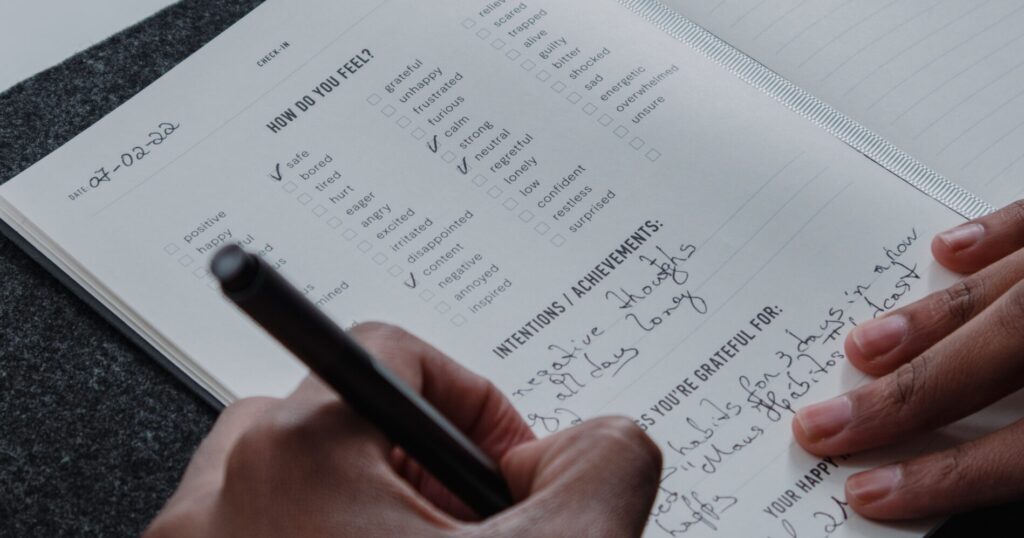
“Outcomes are about what you get. Processes are about what you do. Identity is about what you believe.” – James Clear When I work with coaching clients, we look at both their inner world (self-concept, beliefs, assumptions, mindset) and outer world (behaviors, language). It’s a two-fold exploration of how they experience themselves and how others experience them. Through these two lenses, we can dissect a client’s thought processes and how they play out in their day-to-day interactions. It’s incredibly effective for creating lasting change. Which is why I’m so enamored with James Clear’s model for achieving goals. In his book Atomic Habits, he lays out an approach that feels counter-intuitive. Start by focusing on your identity (self-concept) and then figure out the habits (behaviors) that support that identity. For example, rather than saying, “I want to lose 20lb,” you start by identifying who you want to be. In this case, you might say, “I want to be someone who lives a healthy lifestyle.” You then identify the habits a healthy person might adopt, such as regular exercise or changes in diet. Weight loss is the end result. This process worked well for a client recently, who is averse to networking, despite it being an important part of her role. With the above model in mind, she was able to shift her mindset from, “I need to network more to generate business” (which was anxiety-provoking and demotivating), to one of, “I am comfortable networking.” What habits does someone who is comfortable networking adopt? They may… Armed with this shift in perspective, she created a realistic plan (this is key!) that stretched her outside of her comfort zone, yet set her up for success. This philosophical change, coupled with an attainable habit, provided her the motivation to take new action, which ultimately will yield different results and help her achieve her goal. I love how effective this model is and how well it aligns with the Leadership Fluency Framework and the coaching process. Identity is often one of the first anchors of the framework I explore with clients. In discussing a challenge, leaders will invariably ask, “What should I do?” This is the wrong question. If you’ve worked with me, you know my answer to that question is, “Who do you want to be?” Why? Because when you are clear on the type of leader you want to be and the qualities you want to espouse, what to do becomes more readily apparent. You take the action that aligns with your identity and your values (another anchor in the framework.) If you’re curious about your own leadership fluency, you can check out the Leadership Fluency Appraisal here. And, you can read more about James Clear’s approach here.
Leadership Advice from Ted Lasso

In case you’ve been living under a rock or otherwise occupied over the last few years, Ted Lasso is one of Apple TV’s hit runaway shows (which sadly has just concluded its third and final season.) During the episode in question, Ted is upset that his ex-wife is going to Paris with her boyfriend. It being the “City of Love” and all, Ted is convinced the boyfriend is going to propose and starts to freak out (to the degree Ted freaks out.). Leslie Higgins, one of Ted’s confidantes, wisely suggests: “If anything, you should find out before you flip out.” OK, technically, it’s not advice from Ted himself, but rather from Leslie (so magnificently played, IMHO, by Jeremy Swift). It’s still great advice for any of us who are in relationships with other humans. 🙂 It is in our human nature to jump to conclusions. Our brains are wired to protect us from both physical and emotional harm. To do this effectively, our brain needs to make some assumptions, and the assumption is often a negative one – “Danger ahead!” In the absence of factual information, we construct stories in our heads – about situation outcomes or others’ intentions, thought processes, and motivations. (This is why communication during times of organizational change is so critical!) Leslie’s advice is a leadership call to action to lean into curiosity. We can hit the pause button on assumptions to avoid acting or thinking rashly. It’s an invitation to be intentional and align with our values and leadership vision. Ask questions. Gather the data. Make an informed decision. One of my clients found this strategy particularly useful. He would often get frustrated if he thought situations were not going in accordance with his ideas. Colleagues were uncomfortable with his emotional outbursts and he was becoming difficult to work with. Through coaching, he came up with a strategy to ask a minimum of three clarifying questions about the situation before forming an opinion and reacting. While his questions varied depending on the actual situation, he was always at the ready with a few generic questions such as: The goal is to ask questions to which you don’t already know the answer and uncover more data, and benign enough so as not to put others on the defensive. This strategy served several purposes. The next time you find yourself getting worked up about a situation, take it from Leslie and find out before you flip out.